





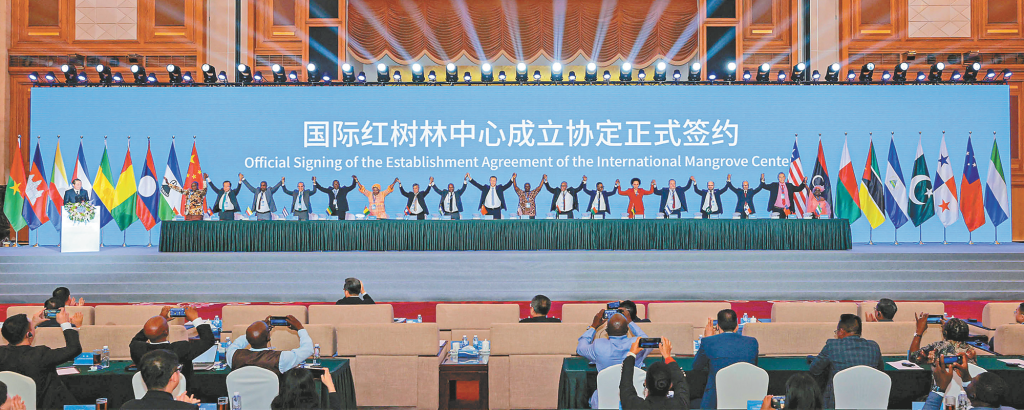
A city can reveal its priorities in many ways.Sometimes, they are visible in innovation hubs and transport networks. Sometimes, they are reflected in planning documents and data dashboards. And sometimes, they can be seen in a quieter scene: a mangrove forest at the edge of a busy metropolis, where migratory birds stop over while millions of people live and work nearby.In Shenzhen, these different aspects of urban development are increasingly becoming part of the same story.Two developments in 2026 offer a glimpse of this approach: the establishment of the International Mangrove Center as an operational international institution, and the global rollout of the Urban Index of Shenzhen (UIS).One focuses on mangroves and coastal ecosystems. The other focuses on urban planning and governance. Yet both reflect the same idea: a modern city must pursue development while protecting nature and improving people’s quality of life.

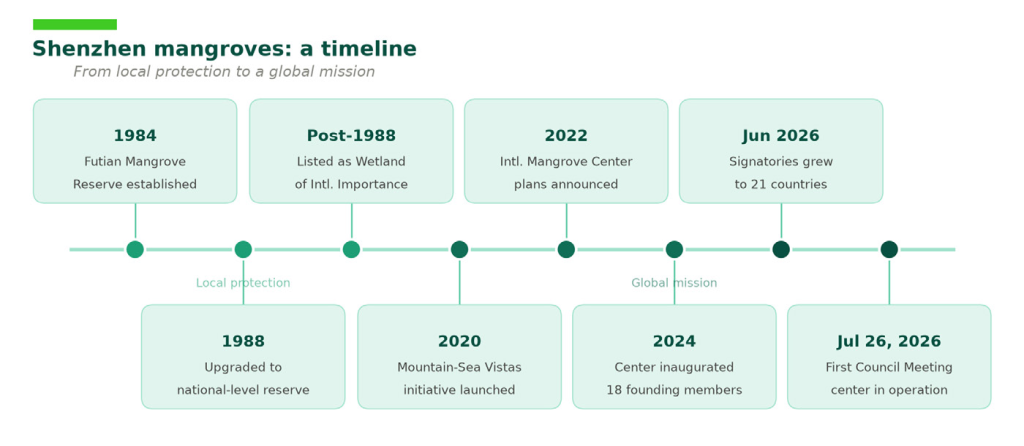
Measuring more than growth The philosophy lies behind the UIS. Jointly developed by the Research Center of Territorial Spatial Planning, Ministry of Natural Resources, Shenzhen Urban Planning and Land Development Research Center, the UIS seeks to turn Shenzhen’s urban development experience into a framework that can be shared internationally.Its central question is: how should we measure whether a city is truly successful?The UIS looks beyond GDP through six dimensions: Innovation, Livability, Aesthetics, Resilience, Humanism, Intelligence.UN-Habitat expert Lorenzo Barrionuevo highlighted citizens’ living experience, ecological harmony and urban resilience. His colleague Salvatore Fundarò stressed that urban evaluation should look beyond GDP and consider areas such as housing affordability, urban culture and technological innovation.Shan Liang, director of the Shenzhen Urban Planning and Land Development Research Center, emphasized that the framework follows internationally recognized evaluation principles while taking into account the realities of cities at different stages of development.From local practice to global knowledge The connection between the two initiatives lies in Shenzhen’s approach to urban governance.With more than 20 million residents in a relatively compact area, the city has long faced the challenge of balancing rapid growth with limited land and ecological resources. It established a basic ecological control line in 2005, while its current territorial spatial plan emphasizes both high-quality development and ecological protection.The result is an approach in which environmental protection is increasingly embedded in planning, infrastructure and everyday urban life. The International Mangrove Center turns this ecological experience into international cooperation. The UIS turns Shenzhen’s broader experience in urban planning and governance into a framework for knowledge exchange.

One begins with mangroves. The other begins with UIS. But both point to the same principle: a city’s success should be measured not only by how fast it grows, but by how well it protects its natural environment, serves its people and prepares for the future.In Shenzhen, a city of symbiosis, the mangroves show what the city chooses to protect. The urban index shows what it chooses to measure. From the mangroves of Shenzhen Bay to the UIS, the city is exploring what harmonious coexistence between humanity and nature can look like in a modern metropolis — and sharing that experience with the world.