





When Shanghai hosted the Ninth APEC Economic Leaders’ Meeting in 2001, the first time such a meeting was held in China, Shenzhen had just celebrated the 20th anniversary of the Shenzhen Special Economic Zone, the testing ground for the country’s reform and opening-up drive.

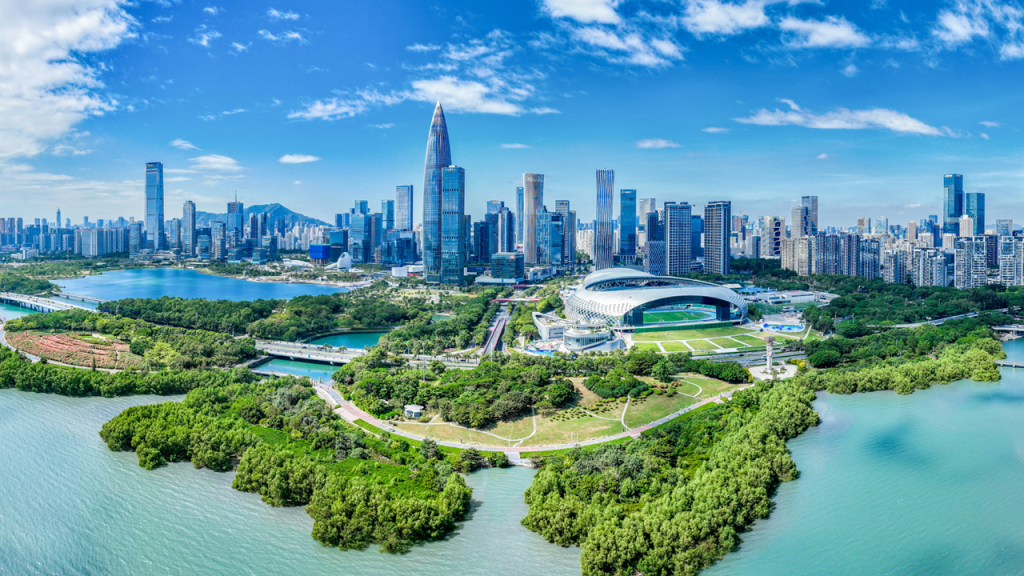
Shenzhen’s economy soared from 196 million yuan (US$29.15 million) in 1979 to 166.52 billion yuan in 2000, representing an extraordinary 848-fold increase, or an average annual growth rate of about 40%, over the period. The city’s trailblazing experiments set an example for other parts of China, and the country went on to become a major world economic power.
The 2001 Shanghai APEC meeting showed the world a country opening up with confidence and embracing globalization, and Shenzhen played a significant part in the China Story.
In 2014, China hosted APEC for the second time, this time in Beijing. The 22nd APEC Economic Leaders’ Meeting in Beijing came four years after China became the world’s second-largest economy.
That year, Shenzhen’s per capita GDP surpassed US$20,000, a milestone that put the city firmly among relatively affluent economies by international standards. Following two decades of economic transformation, Shenzhen continued to deepen reform and opening up. Reform measures unveiled around 2014, such as those formulated in Qianhai and those aimed at promoting innovation and streamlining business registration, unlocked enormous opportunities and vitality.
A retrospective on Shenzhen’s earth-shaking transformation over the past 45 years shows an unswerving pursuit of innovation, with the backbone of its economy shifting from processing to manufacturing and then from early-stage technology development to the emergence of multiple high-tech industry clusters. When the 10th Five-Year Plan first listed high-tech industry as one of the three pillars of the city’s economy in March 2001, the iPod was still months away from rolling out of the assembly line of Shenzhen Foxconn, an Apple contract manufacturer. At the time, Huawei and ZTE’s telecom equipment, flash drives and GSM mobile phones were among the popular products made in Shenzhen.The technology landscape has since evolved constantly. AI terminals, the low-altitude economy, embodied AI robots, the marine economy, commercial aerospace and other sectors now make up new pillars of the city’s advanced manufacturing sector. In the first half of this year, Shenzhen’s high-tech industries recorded rapid growth, with industrial robotics output surging 43.9% and 3D-printer output soaring 58.1% year on year. Shenzhen-produced electric vehicles, drones, advanced medical devices and many other high-tech products have become sought-after items in markets around the world.
An increasingly affluent city also means a bigger market for overseas goods and services. Today’s Shenzhen is home to thousands of cafés and coffee shops, creating a massive market for coffee beans and related products from other parts of the world. Durian from Thailand, Malaysia and other Southeast Asian countries has become a popular fruit in Shenzhen, where a growing number of durian shops and eateries specializing in the fruit are springing up, creating new market opportunities for Southeast Asian durian farmers. According to customs statistics, 26,200 metric tons of durian were imported through Shenzhen ports between April and July this year, representing a year-on-year increase of 40.86%. Shenzhen has been buying an increasing amount of foreign goods. Official figures show that during the first half of this year, Shenzhen imported goods worth 1.37 trillion yuan, representing a stunning 59.8% year-on-year increase. This is a powerful testament to the city’s commitment to international cooperation and a strong rebuttal of protectionism.
The choice of Shenzhen to host APEC in November this year underscores the city’s status as one of China’s major high-tech hubs. Growing from an export-oriented processing base to one of China’s — and the world’s — most important innovation hubs can serve as an interesting case study for APEC economies seeking to shift from resource-reliant to innovation-driven growth. As a city that has taken the lead in China in opening up, promoting technological innovation and expanding international cooperation, Shenzhen embodies the three priorities of APEC 2026: openness, innovation and cooperation.
At the Shanghai APEC meeting in 2001, China was demonstrating that it was ready to join the global economic system; 25 years later, Shenzhen can demonstrate how China has evolved into a major driver of technological innovation and global economic cooperation. Shenzhen provides the perfect setting for leaders of APEC economies to energize practical cooperation in fields such as free trade, the digital economy and AI, with the goal of “Building an Asia-Pacific Community to Prosper Together.”